
Common Sources of Salmonella in Packaged Foods in India

Updated: Mar 26
The Illusion of the Sealed Package
When the topic is about food poisoning, almost every one of us has the very first thought that it is due to Salmonella-infected street food, poultry, or raw milk from cans. The branded, elegantly packaged, tightly sealed commodities that are either securely kept within a warehouse or silently resting on our kitchen shelves are rarely questioned. While consumers see convenience, the people working for food quality, food safety, and testing see this as a battleground.
Over the past few years, many big food brands that we’ve trusted for decades have faced international recalls in a variety of food products, such as spices, snacks, masalas, frozen foods, infant foods, etc. In most cases, the hidden culprit behind these recalls has consistently been Salmonella contamination. In response to this, FSSAI has conducted nationwide enforcement drives and expanded the testing networks in the form of laboratories and mobile testing. FSSAI, in a special surveillance carried out across the country, sought to ascertain the presence of high-risk pathogens such as Salmonella in fish and fishery products, spices, culinary herbs, fresh fruits and vegetables, and other food commodities. It is essential to have basic knowledge of the survival characteristics of Salmonella to monitor its presence at the processing point. Bacteria and viruses are easy to inactivate, and Salmonella, as a bacterium, is more recalcitrant; it can survive in low moisture levels of the food. It is quite resistant to heat, cold, and acidic temperatures. Hence, it is there in food products like peanut butter, roasted and blended spices, and masalas.
After a series of recalls and crackdowns, indeed, perfect, glossy, sealed packaging containing everyday masalas and healthy snacks or premium mixes doesn't necessarily mean it’s safe. To protect consumers and brands from this invisible threat, traditional methods or a single swab test need to be swapped with rapid Salmonella detection kits with advanced molecular biology techniques. This strengthens risk prevention, speed of Salmonella detection, and accuracy and avoids costly recalls and broken trust.
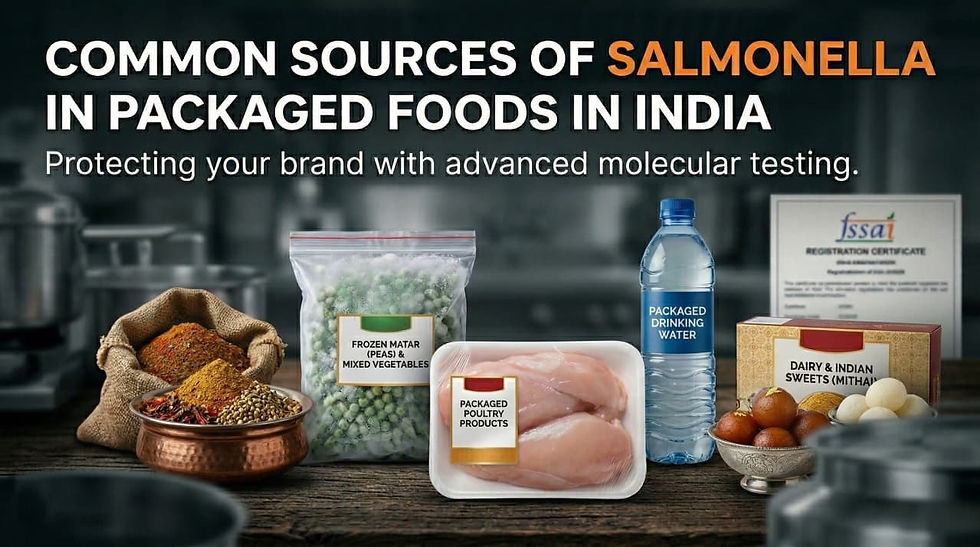
The Top 5 High-Risk Packaged Categories in India
For years, it was believed that if the food is dry, it means safe food by default. Traditionally, dry food meant sun-dried preservation, from Hokh Syun (sun-dried vegetables) to Ker Sangri (dry berries and beans) to Vadis (dried balls with lentil paste) to homemade sambar powder, aamchur powder, and snacks like seviyan, chivda, etc. These days, readily available packaged curry powders, ready-made spice powders, and ready-to-cook mixtures are probably favored over homemade ones due to convenience, though they are often highly processed and mass-produced. This transition from using home-blended pastes to packaged foods produced using modern technologies has altered the nature of microbial contamination, increasing the hidden risks compared to visible risks. The following are the top 5 food categories that are prone to Salmonella infection, according to current recall statistics in India:
Spice powders, seasonings, and organic blends:
Spices and condiments have a massive demand worldwide for their anti-inflammatory and immunity-boosting properties, beyond flavoring. Also, this is one of the categories that face the most common recalls or rejections of shipments in export and domestic markets. Recently, these items have been flagged for their contamination at both domestic and international markets with Salmonella, heavy metals, or pesticide residues and even for adulteration with illegal fillers, which triggers bans.
Frozen fruits and vegetables/snacks
In the current world, frozen fresh produce is not an emergency backup anymore; it's been a part of modern life. Some produce, like fruits and vegetables, is frozen using methods like IQF (Individual Quick Freezing) and air blast freezing. This preserves nutrients, eliminates the process of chopping, making them handy to use, and has a longer shelf life than seasonal produce, therefore reducing the wastage. Consumers often mistakenly believe that treating food with extreme cold, such as freezing, eliminates microbes; however, this is not the case, and there have been recalls in this category. Unfortunately, freezing only puts the bacteria into dormancy, not total death, in the case of Salmonella. This bacterium poses a severe threat when the food product is thawed.
Packaged poultry and meat products
In the rising obsession of proteinholic consumers towards protein for weight management, muscle building, etc., there is a high demand for high- and lean-protein foods, such as eggs, meats, and other protein-based snacks. The practice of buying live birds from butchers in wet markets is slowly fading and shifting towards cleaned, pre-processed, and chilled cuts because of the choices, uniform machine cuts, and presumed low contamination risks. Even after using lower manual intervention and advanced packaging, these products often fail quality checks at labs, especially due to Salmonella and Campylobacter, which many birds carry naturally in their intestinal tracts.
Packaged Drinking Water
Packaged drinking water nowadays is one of the fastest-growing sectors, offering travel convenience and accessibility that perfectly fits the schedule of busy people. Packaged water today is not solely about hydration; there are different products such as mineral water, alkaline water, spring water, functional water, and many more, with different types of filtration methods. Most of the recalls of these packaged drinking waters are because of deadly waterborne pathogens like Pseudomonas aeruginosa, E. coli, yeast, mold, Salmonella, and Shigella. Due to frequent safety failures, FSSAI has categorized all the packaged drinking and mineral water as a high-risk food category.
Dairy and Packaged Indian Sweets (Mithai)
Dairy is a highly perishable commodity, feeding billions of people around the globe. Milk is the main ingredient for a large number of traditional high-value products, such as paneer, ghee, cheese, whey protein, and probiotics, as well as sweets, like rasgulla, milk cake, and many Indian sweets. Owing to their high demand in both domestic as well as international markets and strong economic gains, these products are always in the limelight and often subjected to product recalls.
The following are the three main reasons for most recalls as per FSSAI and other regulatory bodies:
Bacterial contamination (majorly through pathogens like Salmonella, Listeria monocytogenes, and Staphylococcus aureus)
Artificial Chemicals (non-permitted amounts of colors and preservatives)
Aflatoxins and mycotoxins.
The role of Seqlo in mitigating salmonella in food
The week-long wait for petri dish results is largely a thing of the past. With FSSAI looking to make rapid testing compulsory, the consumers are becoming increasingly demanding, and the threat of a product recall hangs over the heads of food businesses like the sword of Damocles it's just not viable to carry on with the way we’ve been testing for pathogens. We’re all too well aware of the dangers of contamination; having to deal with the aftermath of contamination can easily see a business on the brink of financial ruin. Whether it’s spices, dairy, or frozen foods, contamination is always an issue, and the fact that we can test for pathogens quickly and accurately ensures contamination is identified and dealt with before it becomes a major crisis.
Protecting brand equity and bottom-line performance requires certainty and, in most cases, speed.
Seqlo is where the magic of quality assurance transforms from being a never-ending chore to becoming efficient and meaningful. Seqlo provides a fully functional, end-to-end system, optimized for RT-PCR requirements in the food manufacturing industry. With Seqlo’s Salmonella PCR kit, the QA team no longer has to wait for pathogenic bacteria to grow out, thus greatly enhancing productivity and throughput of sample analysis.
Rapid Results: Legacy culture-based testing methods can take 3 to 5 days to achieve accurate and reliable test results; Seqlo’s Salmonella PCR kit delivers the results on the same day in as little as 1 hour, post-enrichment. This expedites informed product quality release and reduction in microbial-contaminated product shipments and reductions in potential product recalls.
High Sensitivity and Specificity: Each Salmonella test kit targets a unique piece of the Salmonella DNA and, as a result, is capable of detecting Salmonella at very low levels in a very specific manner (i.e., few false positives).
Early Supply Chain Intervention: Seqlo’s testing capabilities allow for sampling at almost any stage of the production process. This includes starting materials such as milk and meat, as well as the final product. Detection of contaminants at an early stage in the supply chain helps to prevent potential product recalls and protect consumer safety.
Versatile testing: In addition to Salmonella testing, Seqlo offers testing kits for food-borne pathogens like E. coli, Listeria, Staphylococcus, etc.
The User-Friendly Workflow: Our system has been engineered easily and cost-effectively such that one doesn’t need a PhD to run it. It is easily operable from farm to lab with the least possible manual work
As every lab knows, having a multi-million rupee inventory of packaged products held in isolation for 7 days to prove they are pathogen-free is not very acceptable. At Seqlo, we help labs, industries, and research prove their products pathogen-free in a matter of hours, not days. Be it high-fat peanut butter, risky masalas, or complex frozen legumes, our Salmonella detection kit helps filter out the contaminants that can lead to false positive test results. This helps in confirming that FSSAI’s ‘absent in 25 g' criteria are met before a single batch is dispatched from the loading dock.
Your inventory and revenue shouldn’t be locked down. Your supply chain shouldn’t be held hostage to lab testing. Upgrade to the speed and accuracy of molecular testing.
FAQs
1. Can there be Salmonella contamination in packaged foods like spice powders and snacks?
A: Yes, Salmonella contamination is a risk in packaged foods, like spice powders and snacks. This is true even though they have moisture. Some data shows that 1 in 14 lots of spices have Salmonella contamination.
What salmonella-contaminated packaged foods are subject to the most recalls?
A: The food products, such as organic leaf powders (moringa), eggs, frozen foods, dairy-based creams, pastries, cucumbers, meats, spice powders, etc., were subjected to the most recalls in recent times.
How to identify if the food is Salmonella-contaminated?
A: Salmonella cannot be identified in the food through the naked eye. There will be no visible indications of smell, taste, or appearance. Salmonella can be identified only through laboratory tests such as PCR/ELISA methods.
What are the different methods to detect Salmonella in food?
A: There are different methods to detect Salmonella in food, including culture-based traditional methods, molecular methods, immunological methods, biosensors, etc.
How are molecular methods, such as RT-PCR, most reliable and convenient for detecting Salmonella in food?
A: Molecular methods, such as RT-PCR, provide accurate results within 8-10 hrs including enrichment, compared to the traditional methods, which give results in 5-7 days. RT-PCR is convenient with respect to cost and sensitivity and easy-to-use technology.


Comments